博文

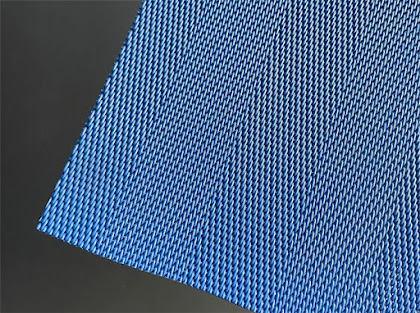
Plain Weave: Tensile Polyester Mesh Screen

图片
WEAVING TYPES AND PATTERNS 1. Plain Weave; 2. Spiral Loops Link Weave. Plain Weave: Tensile Polyester Mesh Screen We can supply 20mesh/ inch, 25 mesh, 30 mesh, 40 mesh, 50 mesh, 60 mesh to 420 mesh, with a maximum roll width of 3750mm. The low elongation dacron mesh is replacing monofilament polyester mesh in screen printing with quick tension forming, high strength, stable tension, and fast printing.  Screen filter mesh  made with material of PA and PET, polyester, and nylon material. Nylon polyester mesh is widely used in liquid and air filtering, mainly textile printing and dyeing, printing plate, electronic printing, ceramics, glass printing, and other industries. Supplied in two forms of processing: needlefelt or woven mesh fabric. We offer 20~1200 micron filter mesh in polyester and nylon material.   Spiral Link Weave: Mesh Belt, Supplied with or without Filled Wire Spiral mesh  is made with round or flat wire in the form of edgeless, loop link, with filling wi...

Screen printing mesh fabric: Nylon or polyester?

图片
In this article, we explain the pros and cons of polyester and nylon mesh for screen printing.   Like every other printing process where several parameters are to be critically controlled,  screen printing , though a simpler process, also needs a strict check on various factors to achieve accurate results. This starts right from selecting a right mesh fabric, mesh size, frames, stretch pressure and many such variables depending upon the requirements of applications. When it comes to screen fabric, there are two kinds available in the industry: nylon and polyester. While polyester is being widely used worldover, nylon is the choice of Indian screen printers for majority of applications. The polyester mesh has several superior properties such as  resistance to solvent, high temperature, water, chemicals etc. Also, when acted upon by severe external pressure, its physical performance is stable and stretchability is low. However, as compared to nylon, polyester has poor wear ...

Tips for choosing filter belts

图片
Filter belts is an indispensable supply for many industries. If you want to get quality filter belts products to meet your requirements at a very reasonable price, you must master some skills and methods when purchasing filter belts. Shop around to buy better products. First, choose the  filter belts  material reasonably according to your own needs. Generally speaking, the filter belt material includes galvanized wire, as well as black steel wire, black iron wire and stainless steel wire. Price and performance vary among different materials. So make a reasonable choice according to your specific needs. Thus you avoid spending unnecessary money.   Second, choose the appropriate mesh size of the filter belts. The specifications of the filter belts are various for you to choose. So purchase filter belts products with the appropriate mesh size that fit the functions you need.   Third, the type of filter belts production p...

Woven Press Filter Belts Sludge Dewatering Belts for Belt Filter Press

图片
Woven Press Filter Belts Sludge Dewatering Belts for Belt Filter Press Description What do you need to tell us when ordering Woven Press Filter Belts  for your belt filter press? Confirm the slurry consistency and solid particle size in the filtrate. Confirm the pH of the filtrate. Operating temperature. Belt filter press type, strength, processing capacity. The length and width of the filter belt. Connection and edge processing types. The breathability of the filter belt. Thickness, the weight of the filter cloth. Woven Press Filter Belts  are multi-functional filter belts with various textures and a wide range of air permeability, which can meet a wide range of dehydration, filtration, drying and other requirements. The sludge Dewatering belt is a kind of press filter belt. It is designed for solid-liquid separation, especially sludge dehydration in the sewage treatment industry. The combination of high-quality polyester or nylon monofilament, weave type as well as the corre...

Double Layer Press Felts

图片
Double layer BOM press felts can be classified by structure into 1+1 composite and double layer MD yarn. BOM felts of 1+1 composite structure consist of two layers of base material with different thickness. These base materials can be altered in construction and size to meet requirements of various paper machines. 1+1 Composite Layer BOM Felt ✴Double Layer Forming BOM Felt ✴ Double Layer Press BOM Felt ✴Double Layer Of MD Yarn BOM Felt ✴Double Layer BOM Special Composite Press Felt ✴Double Layer Top BOM Felt   Benefits ✴High pressure-resistance ✴Good flexibility ✴Excellent permeability ✴Remarkable structural stability ✴Less elongation ✴Excellent tensile strength ✴None vacuum marks, blind hole mark, groove mark   Applications Applied to press types: groove press, vacuum suction press, multi-press, large diameter nip-roll press to meet  the production of high-grade printing paper , newsprint, technical paper, packaging paper, high-grade paper board etc.

Why use polyester for conveyor belts?

图片
Conveyor belts are the driving force behind conveying operations. There are many different types and materials on the market for a wealth of applications. However, there are several different textiles that play an important role in conveyor belts. Uses of textiles in conveyor belts To provide strength for tensioning To provide strength for handling loads Adding rigidity or stiffness, "giving it body" Improves mechanical fastener holding power Improves wear on the conveyor bed Reduces sliding resistance on products or conveyors Fibers Used in Conveyor Belting Synthetic - aramid, nylon, polyester Nylon. Nylon core is used to provide high strength in certain flour, paper, box and wood applications for conveying products or transmitting power. It is used as a width fibre (weft) in conveyor belts to increase tear resistance and fastener retention and to resist abrasion of construction material products. Features and characteristics High strength High elasticity - stretch and shrin...

The Paper Machine Clothing Market is Growing Rapidly

图片
The Paper machine clothing market is expected to grow at a significant CAGR in the coming period as its scope and applications increase dramatically worldwide. paper machine clothing (PMC) is a mechanical device that uses quality fabric solutions to improve the paper making process. Custom-designed fabrics in the right place improve machine performance and productivity. Reliable and durable dryer fabrics make the papermaking process predictable and reduce the need for unexpected fabric changes. Better fiber retention and drainage, productivity, improved paper properties and efficacy play a critical role in PMC. The factors that play a major role in the growth of the  paper machine clothing  market are efficient production systems, cost reductions for various paperboard and paper machines, and the production of high-quality products. However, advancing technologies and the presence of substitutes are factors that will inhibit overall market growth in the coming years.   We...

What materials are available for the conveyor belt?

图片
  Conveyor Belt Materials They must be durable, long-lasting and resistant to a wide range of temperatures, humidity and chemicals. There are five main materials used for conveyor belts: thermoplastics, metal, rubber, fabric and leather. Plastics include polyester, polyvinyl chloride, silicone and polyethylene. Metals are stainless steel and carbon steel, and fabric materials are canvas or cotton. The most popular material is rubber compound because it is flexible, durable, smooth and seamless. It also does not have any holes or openings. For added strength, many belt materials contain additives, including fabric, steel, polyester or fibreglass. Many flat belts are actually made up of a core material and a cover. These belts are part of many different types of conveyor, including trough, inclined, horizontal, food grade and overhead conveyors, but they are not used in chain, pneumatic or screw conveyors. Choosing the correct belt material is the most important specification involve...

Paper forming fabrics are utilized in the whole paper making procedure to help to make paper

图片
1.5 layer forming fabrics   are improved products of single-layer nets, and have actually boosted multilayer net properties by raising the density of the surface weft threads of stickers. The smoothness of the sticker label surface, pulp fiber retention, dewatering performance, and also cleansing performance are all considerably improved. The negative aspect is that it is not wear-resistant and has a brief life span. As soon as the foreign matter has fallen under the internet, the net will certainly not be fixed.   Double layer forming fabrics  usually weave two layers of weft strings right into horizontal double-layer weaves. Compared with single layer forming fabrics, the warp and also weft lines have high density, as well as consequently have the qualities of hard contraction and dimensional stability. The cable diameter and material of the paper-side and machine-side weft yarns can be arbitrarily selected according to the application requirements, thereby enhancing in...

Category and attributes of paper forming fabric products

图片
Paper forming fabrics are utilized in the whole paper making procedure to help to make paper.   Category and also characteristics of synthetic fiber forming fabrics. As a result of its soft material, synthetic fiber forming fabrics can be made for numerous sort of weaving. General forming fabrics in the world today, according to its structure can be roughly divided into single layer (solitary layer of woven) and multilayer (multilayer woven), multilayer includes dual (dual layer weave), 3 layer (triple layer weave), etc.   Solitary layer forming fabrics can be split into ring internet and also plug-in internet according to their knitting procedures. Ring network, likewise referred to as a limitless network, is an endless ring network that is woven directly from an impend. Its structural features are weaving, the longitudinal direction of the paper equipment (MD) for the weft, without the joint fiber yarn for dual weaving at the interface. The longitudinal direction of the plug...

Paper Machine Clothing 1.5 Layer Forming Fabric

图片
Paper Machine Clothing 1.5 Layer Forming Fabric Description 1.5 layer forming fabric  is actually a 5-shed single layer fabric that has modified to have extra yarns which provide it the same properties as that of a double layer one. The extra yarns provide better sheet side smoothness as well as improved retention. Thanks to its unique structure, it delivers very good drainage and ease of cleaning. 1.5 Layer forming fabric is mainly used on the packing paper machine with machine speed 50m-400m/min, which have high air permeability as single layer forming fabric, and have a longer life than single layer forming fabric . Feature Excellent drainage capacity and ease of maintenance Easier to clean, better sheet release and faster drainage than double layer fabrics. Better drainage and fiber support than single-layer fabrics. Longer lifetime and better dimensional stability.

Define the ideal material and fiber

图片
  1. Define the ideal material and fiber ▸Polyester monofilament filter cloth Made of high-strength, low-stretch polyester monofilaments. Smooth surface for easy cake discharge, acid-resistant, wear-resistant and high- The normal use temperature is less than 130 °C (266 °F), and the instantaneous use temperature is 150 °C (302 °F). The normal use temperature is less than 130 °C (266 °F), and the instantaneous use temperature is 150 °C (302 °F). ▸Polyester multifilament filter cloth The series of filter cloth is weaving by the polyester filament in multi-strand. It is acid-resistant, high strength, better intercept ability for fine It is acid-resistant, high strength, better intercept ability for fine particles, but more difficult to clean than monofilament due to the multi-fiber. The normal working temperature is no more than 130 °C (266 °F), and the instantaneous working temperature is 150 °C (302 °F). ▸Polypropylene (PP) monofilament filter cloth Made of polypropylene high-streng...

How to choose the right filter cloth for your horizontal vacuum belt filter

图片
High quality filtration and liquid-solid separation are the keys to the popular horizontal vacuum belt filter. The filter is a relatively simple but efficient machine. With many years of experience in horizontal vacuum belt filter belt development, we have developed horizontal vacuum filter belts that are strong enough to move continuously. We uniquely design fabrics, yarns and braids to be abrasion resistant for long life. One of the benefits of belt filtration is that the operator can usually see the entire process and easily detect any process excursions that occur.     Our belt filtration media has proven to be more cost effective because  it is easy to maintain and clean . We offer single and double layer belts with continuous innovation to improve dimensional stability, high flow rates and longer service life.   Horizontal vacuum belt filter cloths will withstand the forces of repeated suction on a vacuum filter, should have fine pore size for better filtr...

Something you need to know about PMC

图片
  Functions The bottom surface of the formed web contributes to the characteristics of the conveyor belt. Most life-reducing wear occurs on the underside of the fabric as it comes in contact with wear-generating elements such as rolls, foils and flat box covers. Machines with high resistance loads require heavy fabrics to withstand the tensile forces and wear on forming plates, foils, vacuum equipment and rolls. Resistance, fabric wear and lifetime are all related. Mechanically, forming fabrics must have: * Good abrasion resistance * Good guiding and driving ability * Resistance to stretching, narrowing, skewing, wrinkling, puckering and creasing * Resistant to high pressure cleaning sprays * Ability to clean and knock off sheets   Formed fabrics are woven on textile-type looms  using polyester and polyamide yarns. Typical yarn diameters of the forming fabrics are 0.11 to 0.50 mm. Formed fabrics can be woven flat and joined (seamed) to make endless fabrics for paper machi...